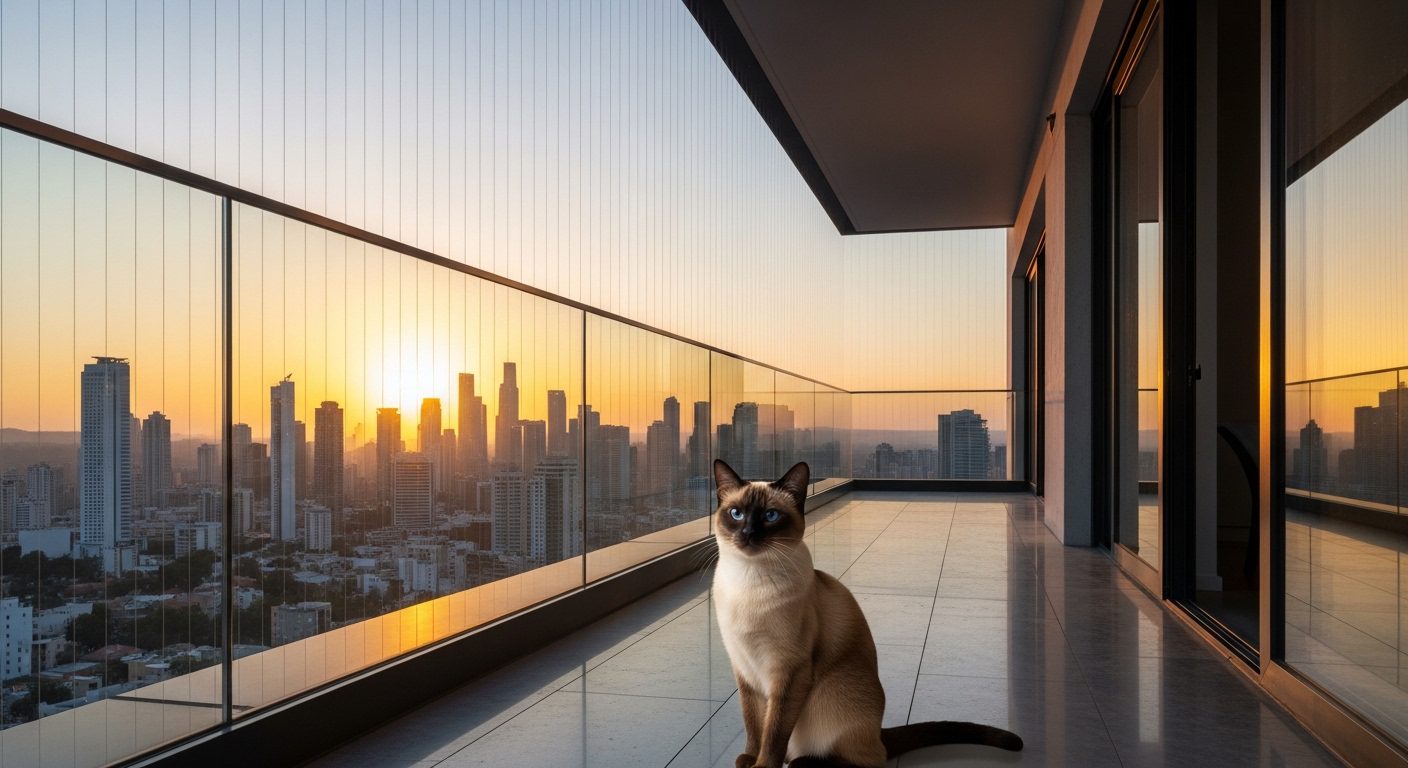
Mastering high-rise cat safety is the absolute most critical responsibility for any urban pet owner living in a modern vertical development. For many city dwellers, the dream of a luxury penthouse with floor-to-ceiling windows or a spacious balcony overlooking the skyline is the ultimate goal.
However, for a feline guardian, these stunning architectural features represent a constant, underlying source of anxiety. “High-Rise Syndrome”—a clinical term used by emergency veterinarians to describe the severe injuries sustained when cats fall from heights of two stories or more—is a tragic and entirely preventable phenomenon that occurs far too often in metropolitan hubs like New York, Toronto, and London.
At Smallpetliving, we believe that achieving total security should never force you to live in a dark, boarded-up box or sacrifice your multi-million-dollar city views. By utilizing modern engineering, invisible protection systems, and strategic behavioral redirection, you can create a high-performance safety net that respects both your cat’s predatory instincts and your apartment’s high-end aesthetic. This comprehensive guide goes beyond basic advice; we provide you with the exact blueprints, installation protocols, and Homeowners Association (HOA) negotiation tactics you need to permanently feline-proof your luxury apartment.
The Physics and Psychology of Feline Falls
To effectively manage vertical security in an apartment, we must first dismantle the dangerous myth that “cats always land on their feet.” While felines possess a remarkable vestibular system and a “righting reflex,” the physics of falling from a skyscraper are unforgiving.
According to veterinary trauma data from the ASPCA, falls from intermediate heights (between 2 to 7 stories) can sometimes result in worse injuries than higher falls, as the animal does not have sufficient time to reach terminal velocity, relax its muscles, and assume a “parachute” posture to spread the impact.
Furthermore, cats do not jump off balconies because they are suicidal or clumsy. They fall because of their acute predatory drive. A bird flying past a 30th-floor balcony triggers an involuntary hunting lunge. In that split second, the cat’s brain ignores the sheer drop. This is why behavioral “training” is insufficient for balconies; you require literal, physical barriers.
Strategy 1: The Invisible Polyamide Netting (The Gold Standard)
The most robust solution for open balconies is high-tenacity Polyamide (Nylon) monofilament netting. Unlike ugly metal grilles or thick green garden mesh, premium polyamide nets are 0.8mm to 1.1mm thick and virtually invisible from a few feet away.
The HOA Negotiation Tactic
In luxury condos, the HOA or Condo Board will strictly prohibit anything that alters the building’s exterior facade.
- Your Strategy: Do not ask for permission using the word “fencing.” Submit a formal request to install “Architectural Transparent Monofilament.” Provide the board with a sample of the 0.8mm clear wire and the technical spec sheet proving it is UV-treated and visually imperceptible from street level. Highlight that it is a reversible, non-damaging installation.
Strategy 2: Step-by-Step Balcony Net Installation (The “No-Drill” Solution)
If your building prohibits drilling into the exterior masonry, you must use a tension-based framework. Here is the literal solution for a structural, drill-free installation:
- The Tension Poles: Purchase heavy-duty, floor-to-ceiling telescoping tension poles (similar to industrial cargo bars). Place one pole in each corner of your balcony, and space additional poles every 4 to 5 feet along the open edge. Tighten them securely between your balcony floor and the concrete ceiling above you.
- The Perimeter Cable: Run a 2mm stainless steel wire rope around the top, bottom, and sides of your new pole frame. Use heavy-duty zip ties or steel clamps to secure the cable to the poles.
- Lacing the Net: Take your transparent polyamide net and use a specialized lacing cord (provided by the net manufacturer) to weave the net onto the stainless steel perimeter cable.
- The Tensioning: Pull the net taut. A properly installed safety net should bounce back like a tennis racket. If it sags, it is dangerous, as a cat can become tangled.
Strategy 3: Upgrading to High-Tenacity “Pet Screens”
If you rely on operable windows rather than a balcony, standard fiberglass insect screens are a massive liability. A 12-pound cat leaning against a standard screen to chatter at a pigeon will easily pop the mesh right out of its aluminum frame.
- The Solution: You must replace the standard mesh with “Pet Screen” material—a heavy-duty, vinyl-coated polyester that is up to seven times stronger than traditional fiberglass.
How to Install Pet Screens in Existing Luxury Frames
- Remove the Frame: Take the window screen frame out of the window track and lay it flat on a large table.
- Remove the Spline: Use a flathead screwdriver to pry out the old rubber “spline” (the cord holding the mesh in the groove) and discard the flimsy fiberglass mesh.
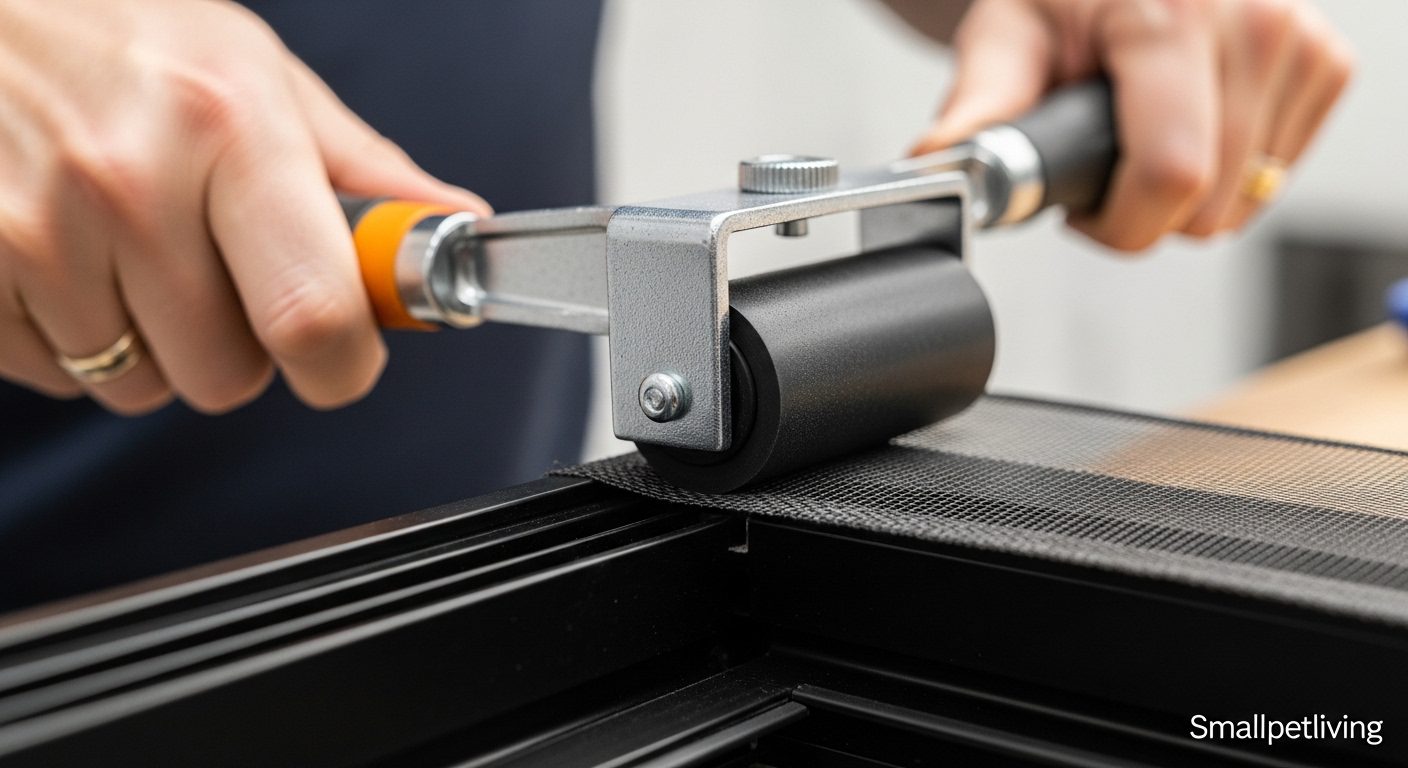
- Roll the New Mesh: Lay the heavy-duty Pet Screen over the frame. Because this material is thicker, you will likely need to purchase a slightly thinner rubber spline (e.g., 0.125-inch instead of 0.140-inch) so it fits into the groove with the thicker mesh.
- The Spline Tool: Use a concave spline roller tool to press the rubber cord over the mesh and deep into the aluminum channel, pulling the screen taut as you go. Cut the excess mesh with a utility knife.
Strategy 4: Sash Limiters and Restrictors for Sliding Windows
For high-end apartments that feature large sliding glass doors or awning windows, replacing screens isn’t always possible. In these scenarios, preventing the window from opening wide enough for a cat to escape is the primary objective.
- The 4-Inch Rule: A feline skull can squeeze through surprisingly small gaps. As a rule of feline anatomy, if the head fits, the body will follow. Your windows must never open more than 4 inches (10 cm).
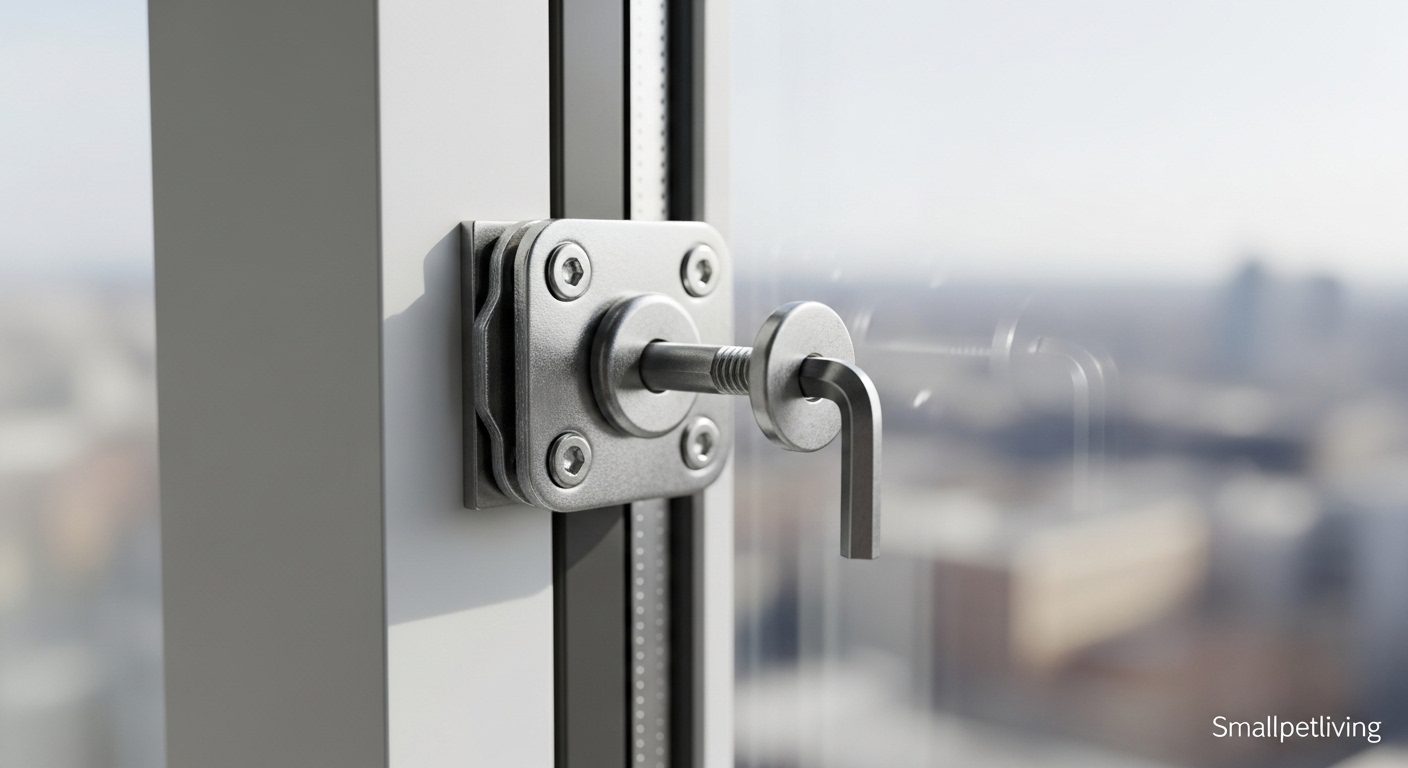
- The Literal Solution: Purchase commercial-grade, track-mounted window restrictors. These heavy-duty metal blocks clamp directly onto the sliding track of the window and are secured with an Allen wrench. Unlike cheap plastic child locks that stick on with adhesive (which degrade in the sun), a track-mounted steel clamp physically blocks the window from sliding past your designated 4-inch mark. This ensures constant fresh air flow without compromising your feline’s safety.
Strategy 5: The “Double-Gate” Foyer Air-Lock System
A frequently overlooked aspect of high-rise cat safety is the front door. Long, carpeted apartment hallways can trigger curiosity or panic in a cat. If they slip out while you are signing for a package, they can easily get lost in stairwells or elevator shafts.
- The Strategy: Create an “air-lock” in your entryway.
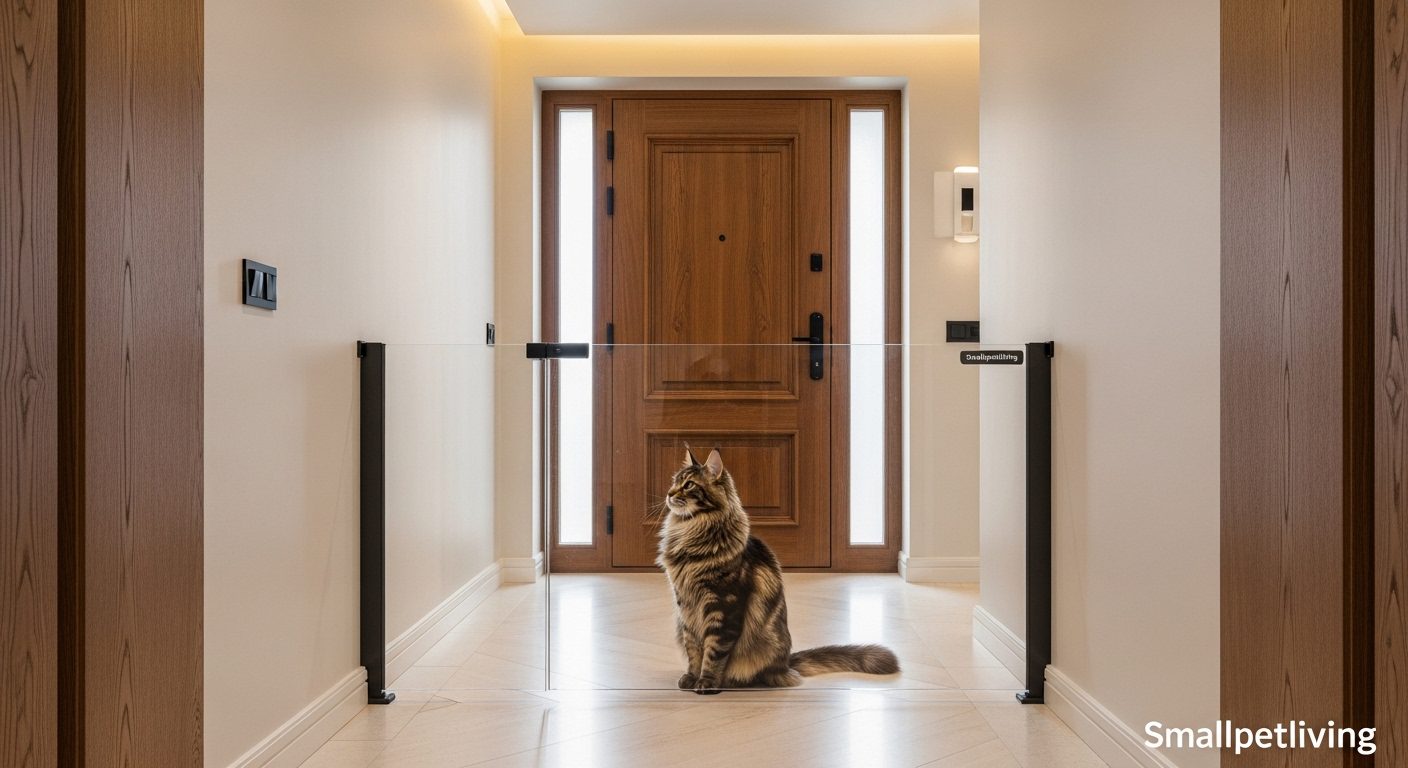
- The Installation: Install an extra-tall (at least 38 inches), pressure-mounted acrylic pet gate in your foyer corridor. By using clear acrylic rather than metal bars, you maintain the minimalist aesthetic of your home while creating a secondary physical barrier. When you open your front door, the cat is safely contained behind the gate, giving you total peace of mind when greeting guests.
Strategy 6: Safe Vertical Redirection (Internal Territories)
Cats climb because they seek vantage points to survey their territory. If you block their access to the balcony ledge, you must provide a safe internal alternative to prevent psychological frustration. This ties directly into our previous guides on setting up a cat-friendly studio apartment.
- The Execution: Install an architecturally pleasing window perch via heavy-duty suction cups on a non-operable, fixed pane of glass.
- Behavioral Benefit: By offering a safe, highly elevated bed inside the sealed glass, you allow your cat to engage in “bird watching” and sunbathing without exposing them to the physical dangers of an open ledge.
Strategy 7: The Quarterly Tension and Degradation Audit
Safety hardware is subject to wear and tear. Constant exposure to UV rays, coastal salt air, and dramatic temperature shifts can degrade even the best materials. To guarantee ongoing protection, you must implement a strict maintenance routine.
- The 90-Day Protocol: Every three months, perform a manual audit.
- Check the tension of your polyamide net; it should not yield more than an inch when pressed.
- Inspect the rubber spline on your pet screens for dry rot or cracking.
- Test your track-mounted window limiters to ensure the Allen screws haven’t vibrated loose over time.
Engineering Peace of Mind
Implementing robust high-rise cat safety measures is not about restricting your pet; it is about liberating yourself from worry. By utilizing high-tenacity invisible netting, upgrading to industrial-strength pet screens, and installing strategic window restrictors, you eliminate the catastrophic “what ifs” from your daily urban life. Your luxury apartment remains a stylish, light-filled, and breezy sanctuary, and your feline companion remains exactly where they belong: safe, happy, and thriving high above the bustling city streets.
Frequently Asked Questions (FAQ)
Q: Can I use a walking harness and leash instead of netting my balcony? A: At Smallpetliving, we strongly advise against using a leash and harness as a substitute for structural barriers on a balcony. A cat can easily slip out of a harness, or worse, jump off the ledge and become suspended in mid-air, leading to strangulation or severe orthopedic injury. Harnesses are for active, supervised ground walks, not for high-altitude lounging.
Q: Do cats have a natural fear of heights? A: Yes, felines are acutely aware of depth and height. However, their predatory instinct—the biological drive to chase a passing bird or insect—temporarily overrides their fear response. This momentary lapse in judgment is what leads to falls.
Q: My luxury condo has floor-to-ceiling glass but a tiny 2-inch gap at the bottom of the balcony glass. Is that dangerous? A: Yes. While a 2-inch gap is too small for an adult cat to fall through, a kitten could easily slip under. Furthermore, adult cats can get their paws or collars stuck in these gaps, causing panic and injury. Use clear acrylic baseboards to block any structural gaps seamlessly.
Q: Are standard child-safety window locks strong enough for a heavy cat? A: Not always. According to experts at the International Association of Animal Behavior Consultants (IAABC), a 15-pound cat launching itself at a window can generate significant kinetic force. Always opt for steel, track-mounted restrictors rather than adhesive-backed plastic locks.
You Might Also Like
- How to Set Up a Cat-Friendly Studio Apartment
- Quiet Cat Toys for Thin-Wall Apartments
- 5 Reasons Your Apartment Cat Needs a Window Perch
- 7 Small Cat Breeds for Apartments
About Smallpetliving
Smallpetliving is the premier digital resource for upscale urban pet ownership. We specialize in evidence-based strategies, high-end pet gear, and behavioral protocols tailored for high-density, limited-space environments. Our mission is to ensure that city dwellers never have to choose between a sophisticated, meticulously designed home and the safety and well-being of their pets. We bridge the gap between elite metropolitan architecture and world-class animal welfare.