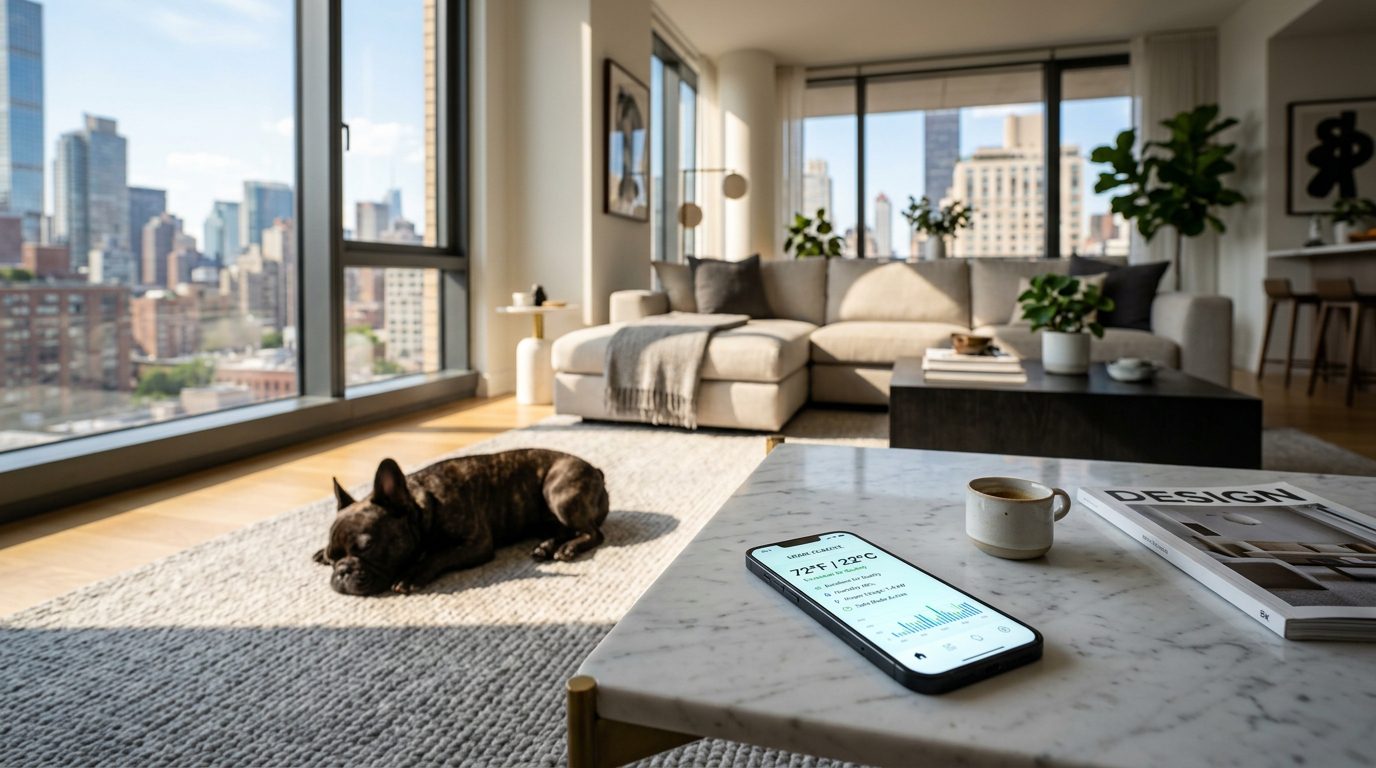
The modern luxury high-rise apartment is an architectural marvel of glass, steel, and climate-controlled comfort. Floor-to-ceiling windows offer breathtaking metropolitan views and flood your living space with natural sunlight. However, for an urban pet owner, this magnificent architectural design harbors a silent, catastrophic vulnerability. On a sweltering July afternoon, if the building’s centralized HVAC system fails, or if your local power grid experiences a sudden blackout, your beautiful glass-walled apartment instantly transforms into a lethal greenhouse.
Unlike a suburban house where a dog might find a cool basement or a shaded backyard, an apartment offers zero escape routes. In these critical moments, relying on a pet temperature monitor for apartment safety transitions from a mere technological luxury to an absolute, non-negotiable lifesaving necessity.
At Smallpetliving, we understand that the deepest anxiety of a working professional is the inability to protect their companion from invisible threats while at the office. You cannot manage a crisis you are unaware of. Standard smart home thermostats are fundamentally inadequate for pet safety, as they measure the ambient air at human eye level in central corridors, completely ignoring the micro-climates where your pet actually rests. Securing a dedicated environmental sensor guarantees that you are never operating in the dark.
This comprehensive, highly technical guide explores the profound physiological risks of urban heatstroke, the critical difference between Wi-Fi and cellular monitoring networks, and the 6 elite protocols you must establish to ensure your pet is never left defenseless against the elements.
1. Understand the Physiology of Urban Heatstroke
To fully grasp why environmental monitoring is critical, we must examine how felines and canines regulate their internal body temperature—a biological process fundamentally different from our own. Humans rely on a vast network of sweat glands to cool the skin through evaporation. Pets do not have this evolutionary advantage.
According to the strict clinical guidelines established by the American Veterinary Medical Association (AVMA) regarding heat stress, dogs and cats can only cool themselves by panting (which exchanges warm internal air for cooler outside air) and through minor sweat glands located exclusively on their paw pads.
In a sealed apartment with a failing air conditioner, the ambient temperature can spike from a comfortable 72°F to a deadly 90°F in less than 90 minutes. As the indoor air becomes stagnant and hot, panting becomes entirely biologically ineffective. The animal’s core temperature rapidly elevates, leading to heat exhaustion, irreversible organ damage, neurological seizures, and fatal cardiac arrest. This risk is exponentially magnified for brachycephalic (flat-faced) breeds like French Bulldogs, Pugs, and Persian cats. A dedicated monitor provides the early warning necessary to intervene before this biological threshold is ever crossed.
2. The Cellular Mandate: Bypassing Wi-Fi Blackouts
When selecting a pet temperature monitor for apartment integration, you will immediately face a technological fork in the road: should you purchase a device that connects to your home Wi-Fi network, or one that utilizes a standalone cellular data connection?
The Vulnerability of Standard Wi-Fi
Wi-Fi-enabled sensors are convenient and require no ongoing subscription fees. However, they possess a fatal flaw. The most common cause of air conditioning failure in the summer is a rolling blackout or a blown neighborhood transformer. When the power cuts out, your apartment’s Wi-Fi router instantly dies. A Wi-Fi-based temperature monitor will go entirely offline exactly when you need it the most.
The Elite Alternative
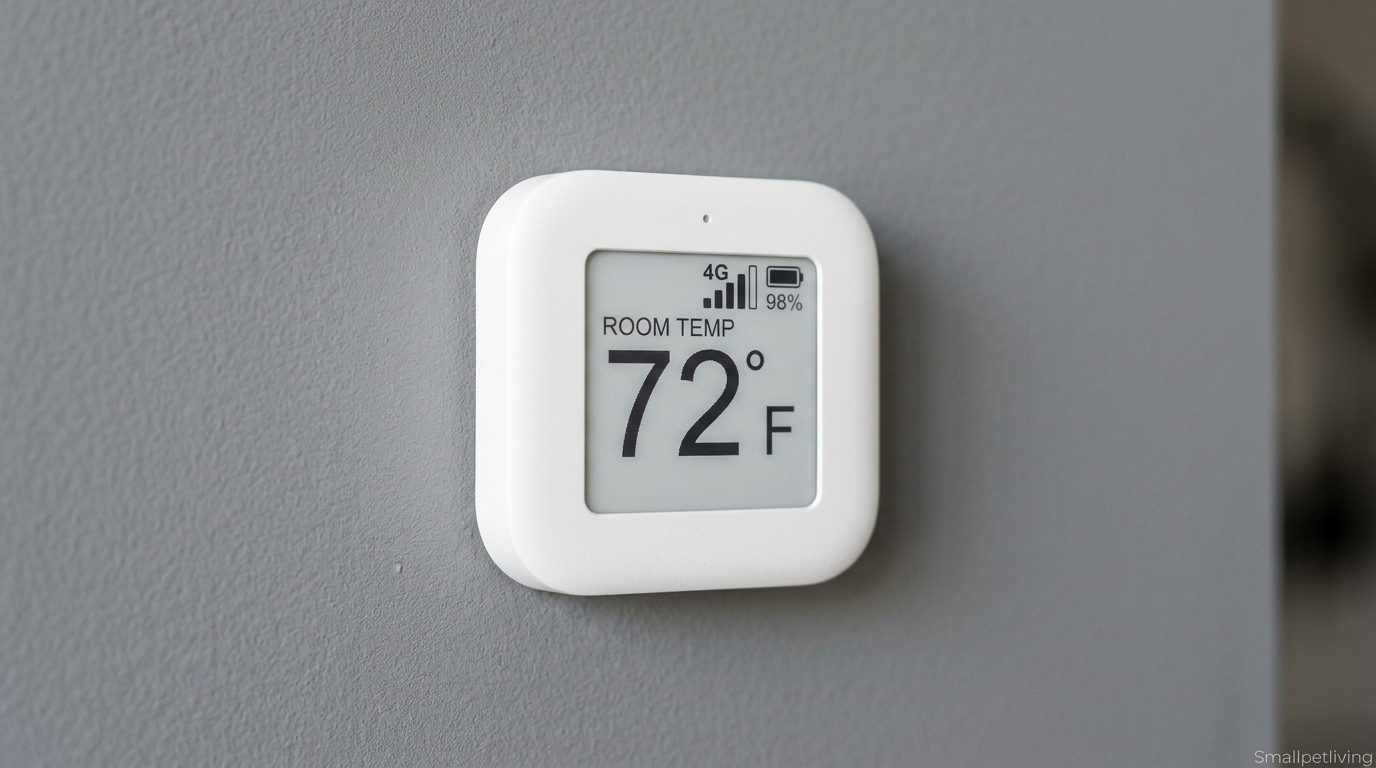
For uncompromising safety, a cellular-based monitor (such as the Waggle Pet Monitor) is the elite standard. These devices contain internal, long-lasting rechargeable batteries and their own dedicated SIM cards. If your apartment loses power, the cellular monitor continues to broadcast the rising room temperature and humidity directly to your smartphone via SMS and app push notifications. The redundancy it provides is the only way to guarantee a fail-safe alert system.
3. Strategic Zonal Placement for Micro-Climates
Purchasing the highest-end sensor on the market is useless if it is installed in the wrong location. To effectively utilize a pet temperature monitor for apartment spaces, you must measure the exact micro-climate your pet inhabits, not the general hallway.
Avoiding False Positives
- Direct Sunlight: Never place the sensor on a windowsill or an area of the floor that receives direct afternoon sunlight. The solar radiation will bake the plastic casing of the sensor, triggering a false alarm (e.g., reading 95°F) while the rest of the apartment remains a cool 70°F.
- The HVAC Draft: Conversely, do not place the monitor directly beneath an air conditioning vent. It will read artificially low, providing a false sense of security while a different room where your pet is sleeping might be dangerously hot.
- The Perfect Location: Place the sensor at your pet’s physical level (one to two feet off the floor), mounted on an interior wall, directly adjacent to their primary resting area, such as next to their space-saving crate or orthopedic bed.
4. Smart Ecosystem Integration: Automating the Rescue
In a true luxury smart home, technology does not merely alert you to a problem; it actively attempts to solve it before human intervention is required.
IFTTT and Climate Automation
If you choose a high-end Wi-Fi sensor, ensure it features integrations with platforms like IFTTT (If This Then That), Apple HomeKit, or Google Home.
- The Automated Response: You can program a sophisticated chain of events. For example, if the pet temperature monitor for apartment safety detects that the living room has crossed the 78°F threshold, it can automatically trigger motorized smart blinds to close (blocking the greenhouse effect of the sun) and simultaneously activate a smart plug connected to a heavy-duty floor fan to circulate the stagnant air. This buys you precious hours to return home and physically extract your pet.

5. Calibrating Clinical Thresholds to Prevent Alert Fatigue
A common mistake new users make is setting the temperature alerts too tightly. If your system is sending you a frantic push notification every time the apartment fluctuates by a single degree, you will quickly develop “alert fatigue.”
Setting the Baseline
When you receive too many notifications, your brain begins to ignore them.
- Temperature Limits: Consult your veterinarian for your specific breed, but a general baseline for a healthy adult dog or cat is to set the preliminary “Warning” alert at 78°F (25.5°C) and the “Critical Emergency” alert at 82°F (27.7°C).
- Humidity Matters: Ensure your chosen device also measures Relative Humidity. An apartment sitting at 78°F with 30% humidity is entirely safe. That exact same temperature with 80% humidity is incredibly dangerous, as high moisture prevents effective panting. Set your humidity threshold alert for anything above 65%.
6. Executing the Urban Emergency Extraction Protocol
Receiving a critical temperature alert on your smartphone while you are sitting in a boardroom 45 minutes away is a terrifying experience. The technology has done its job; now the human protocol must execute flawlessly.
Building Your Response Network
You cannot teleport through city traffic. A successful intervention requires a pre-established network.
- The Spare Key: You must have a trusted neighbor on your floor, or the building superintendent, who possesses a physical spare key to your unit.
- The Action Plan: When the critical alert fires, immediately call your emergency contact. Instruct them to enter the apartment, physically leash the dog or crate the cat, and move them into the climate-controlled building lobby or hallway.
- The Go-Bag: Ensure your emergency evacuation go-bag is easily accessible near the front door so your neighbor can quickly grab your pet’s travel water bowl and medical records.

Engineering Absolute Peace of Mind
Integrating a pet temperature monitor for apartment safety is the ultimate hallmark of a responsible, technologically advanced urban pet owner. The illusion of safety provided by central air conditioning shatters the moment the power grid fails. By rejecting standard thermostats in favor of localized, cellular-backed environmental sensors, you eliminate the blind spots in your home’s security. Establishing precise clinical thresholds, automating smart home responses, and building a trusted physical extraction network ensures that your pet is never left at the mercy of the elements. You can finally navigate the metropolis, attend to your career, and live your urban life with the absolute, uncompromising certainty that your companion is breathing cool, safe air.
Frequently Asked Questions (FAQ)
Q: Can I just use my existing indoor security camera to monitor the temperature? A: It depends on the model. Some premium pet cameras have built-in climate sensors, but many do not. Even if they do, they are entirely dependent on your apartment’s Wi-Fi. If a blown fuse cuts the power to the camera, you lose both the video feed and the temperature data simultaneously. A standalone, battery-powered cellular monitor is vastly safer.
Q: Are there any monthly fees associated with a pet temperature monitor? A: Wi-Fi-only monitors generally have no monthly fees. However, elite cellular monitors (which use mobile data to bypass Wi-Fi outages) require a subscription to maintain their active SIM card. This usually costs between $10 to $15 a month—a negligible price for absolute fail-safe security.
Q: Will a smart thermostat like a Google Nest or Ecobee protect my pet? A: Not entirely. Smart thermostats are mounted high on the wall in central hallways and measure the ambient temperature for human comfort. Cold air sinks and hot air rises; the temperature a foot off the floor where your French Bulldog is sleeping can be drastically different from what the wall thermostat reads. You need localized sensors.
Q: How do I cool my dog down immediately if the AC breaks and I am home? A: Move them away from all windows. Offer cool (not ice-cold) water to drink. Dampen a towel with cool water and drape it over their paws, armpits, and groin area, then direct a floor fan straight at them. Never submerge a hot dog in an ice bath, as this causes blood vessels to constrict and traps the lethal heat inside their core organs.
Q: Do temperature monitors also alert me if the apartment gets too cold in winter? A: Yes. High-end monitors allow you to set both high and low thresholds. While urban apartments rarely freeze to death-inducing levels due to shared wall insulation, an alert indicating the heat has failed allows you to bring your pet a heavy blanket or sweater before they become profoundly uncomfortable.
Q: Can I place the temperature sensor inside my dog’s crate? A: You can, provided the dog is not a heavy chewer. If you have a puppy or a destructive chewer, mounting a plastic sensor inside the crate presents a severe choking hazard and battery ingestion risk. Mount it securely on the wall just outside the crate instead.
Q: What is the ideal ambient temperature for a cat left alone in an apartment? A: Cats have a slightly higher baseline body temperature than humans and generally tolerate heat better than dogs. Most indoor cats are perfectly comfortable between 70°F and 80°F. However, senior cats or those with feline asthma require stricter, cooler climate control to prevent respiratory distress.
Q: Does my building management have the right to enter my apartment if the alarm goes off? A: Legally, most luxury lease agreements allow building management or maintenance to enter a unit without notice in the event of an “emergency” (like a burst pipe). A failing AC endangering an animal’s life is a grey area. It is best to establish a written protocol and permission with your superintendent beforehand.
You Might Also Like
- 7 Best Pet Friendly Fabrics for Luxury Sofas
- Soundproof Apartment Door Dog Barking: 5 Brilliant Solutions
- 7 Lifesaving Strategies for Apartment Pet Emergency Evacuation
- Prevent Pet Obesity in Small Apartments: 7 Crucial Hacks
About Smallpetliving
Smallpetliving is the premier digital authority for high-end urban pet ownership. We specialize in providing evidence-based safety strategies, architectural-friendly gear, and advanced management protocols tailored specifically for high-density, high-rise environments. Our mission is to bridge the gap between luxury metropolitan interior design and world-class animal welfare, ensuring your home remains a pristine, uncompromising sanctuary.