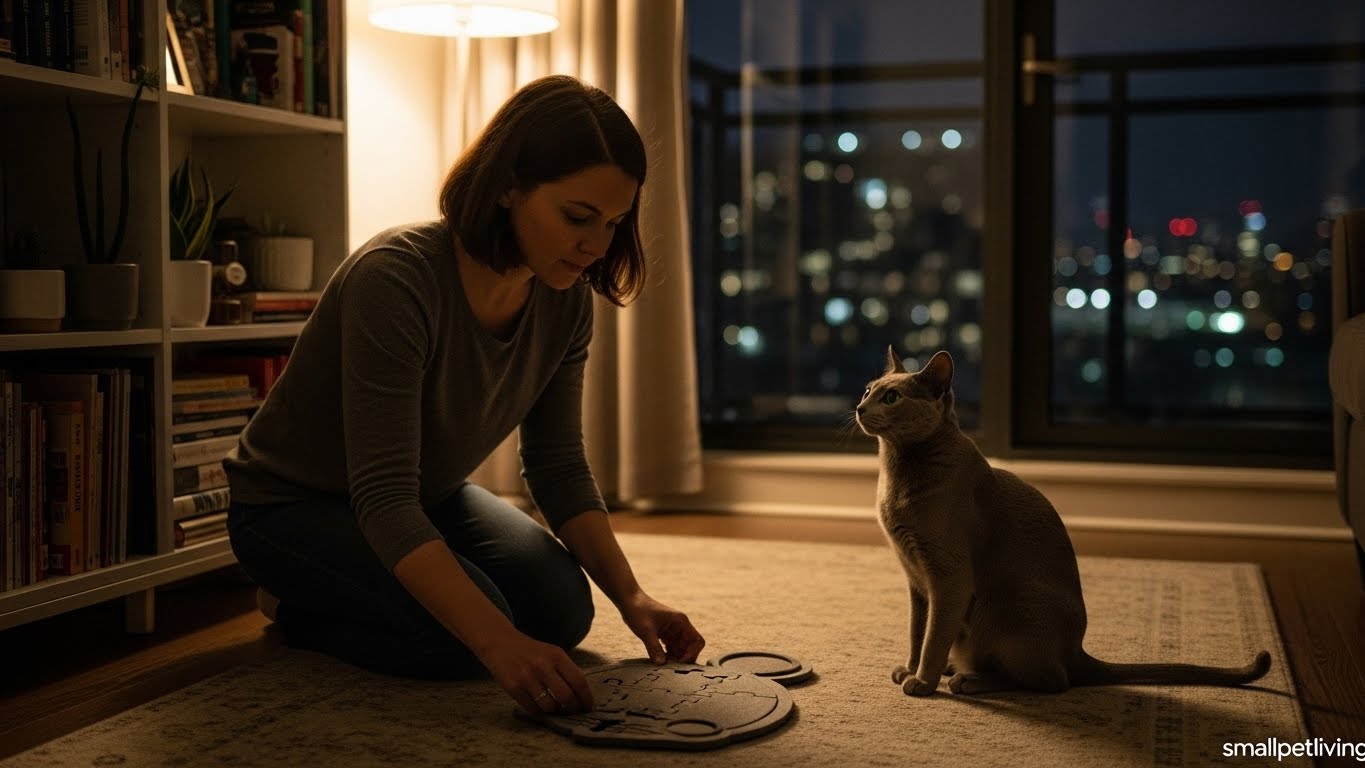
If you live in an apartment with thin walls, you know this fear: the midnight crash of a toy hitting the floor, the frantic 3 a.m. zoomies across hardwood, or the sudden thud of your cat leaping off the fridge—followed by the dreaded knock on the wall from your neighbor.
But here’s the good news: your cat doesn’t need loud toys to be happy. In fact, many of the most enriching activities for cats are completely silent. The right quiet cat toys for thin-wall apartments can keep your feline mentally sharp, physically active, and emotionally fulfilled—without a single noise complaint.
Backed by feline behavior research from the International Society of Feline Medicine (ISFM) and real-world urban pet success stories, this guide reveals 6 truly silent enrichment ideas that work—even for high-energy breeds.
Why Noise Matters More Than You Think
In shared buildings, sound travels. What feels like “normal play” to you can feel like chaos to someone on the other side of the wall. And chronic noise stress affects not just your neighbors—it affects your cat too.
Cats thrive in predictable, calm environments. Loud crashes, rattling balls, or squeaky toys can actually overstimulate sensitive cats, leading to anxiety or redirected aggression.
The solution? Silent enrichment—toys and activities that engage the mind and body without disturbing the peace.

What Makes a Toy “Quiet” (And Still Fun)?
A truly quiet cat toy meets three criteria:
- No hard impacts (no plastic balls on tile)
- No electronic sounds (no beeps, squeaks, or buzzes)
- Soft materials only (felt, fabric, cardboard, wool)
Bonus if it encourages natural behaviors: hunting, stalking, pouncing, and problem-solving.
The 6 Best Quiet Cat Toys for Thin-Wall Apartments
1. Felt Mouse Puzzle Boards
- Why it works: Soft felt mice hide in fabric pockets; cat must use paws to “hunt” them
- Noise level: Zero
- Urban perk: Lies flat—no rolling, no bouncing
- Pro tip: Rotate scents (catnip, silvervine, valerian) to renew interest
2. Cardboard Tunnel Mazes
- Why it works: Encourages exploration, hiding, and ambush play
- Noise level: Whisper-quiet crinkles (if any)
- Urban perk: Collapsible, stores flat under bed
- Best pick: Fringe Studio Hide & Seek Tunnel (recycled materials)
3. Wool Ball Track Systems
- Why it works: Felt or wool balls roll slowly in enclosed tracks—no flying projectiles
- Noise level: Soft thud (absorbed by carpet or rug)
- Urban perk: Keeps play contained in one zone
- DIY option: Use PVC pipes cut in half + wool balls
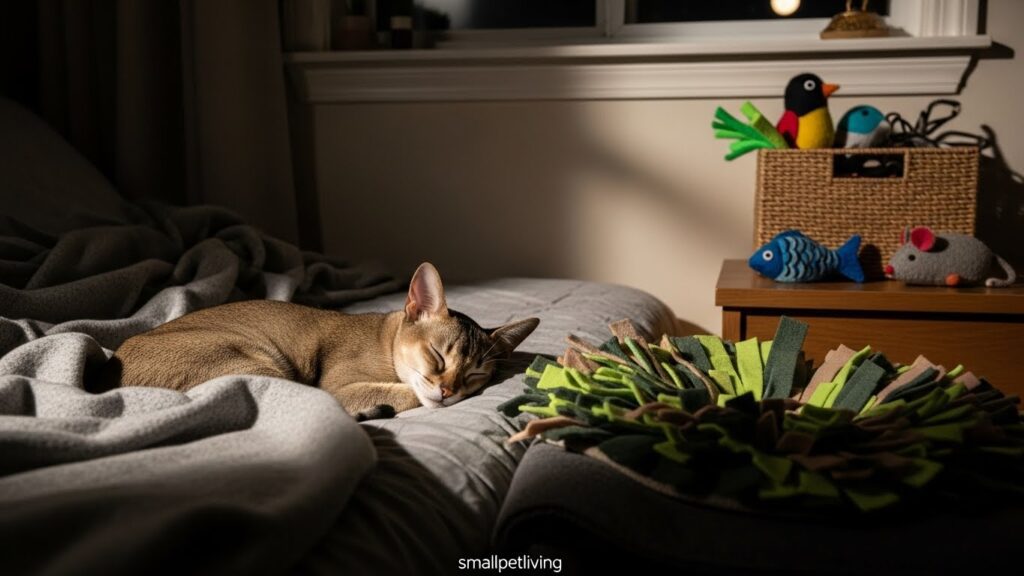
4. Snuffle Mats (Fabric Foraging Pads)
- Why it works: Hide kibble or treats in fabric folds; cat uses nose and paws to “forage”
- Noise level: None
- Urban perk: Doubles as feeding enrichment—slows eating
- Science note: Mimics natural hunting rhythm, reducing anxiety
5. Wall-Mounted Feeder Puzzles
- Why it works: Attach to wall; cat bats at compartments to release food
- Noise level: Minimal (food drops into soft tray)
- Urban perk: Saves floor space, no rolling parts
- Top choice: Trixie Activity Wall Board
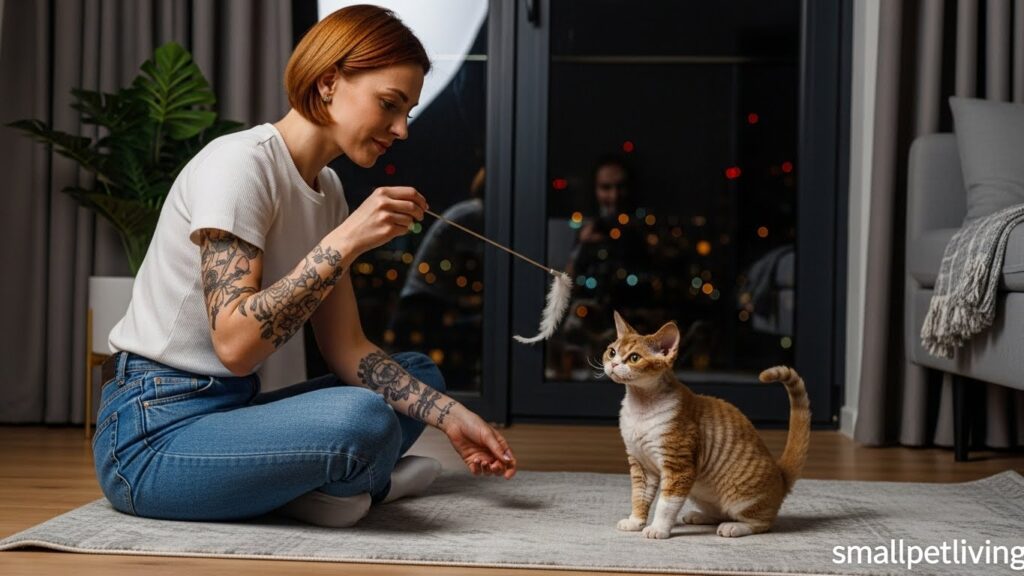
6. Interactive Hand-Wand Sessions (Done Right)
- Why it works: 10-minute daily sessions mimic hunting—exhausts energy silently
- Noise level: None (if you avoid jingle bells or plastic tails)
- Urban perk: Builds bond, prevents nighttime chaos
- Key: End with a “kill” (let them catch a soft toy) to complete the hunt cycle
What to Avoid—Even If It’s “Fun”
- ❌ Plastic balls → bounce endlessly on hard floors
- ❌ Squeaky toys → guaranteed noise complaints
- ❌ Electronic motion toys → buzzing, clicking, whirring
- ❌ Jingle bells → sound carries through walls like alarms
These aren’t “bad” toys—they’re just wrong for thin-wall living.
The Nighttime Play Protocol (Stop 3 a.m. Zoomies)
Most midnight chaos comes from pent-up energy. Fix it with this routine:
- 7 p.m.: 10-minute wand session (end with a “kill”)
- 8 p.m.: Feed dinner via puzzle feeder or snuffle mat
- 9 p.m.: Offer a quiet solo toy (e.g., wool ball track)
Within 3–5 days, your cat will sleep through the night—and so will your neighbors.
Quiet Cat Toys Comparison
| Toy Type | Noise Level | Best For | Space Needed |
|---|---|---|---|
| Felt Mouse Puzzle Board | Silent | Indoor hunters, seniors | Small (12×12 in) |
| Cardboard Tunnel Maze | Near-silent | Shy or anxious cats | Medium (collapsible) |
| Wool Ball Track | Soft thud | High-energy cats | Medium (floor-based) |
| Snuffle Mat | Silent | Food-motivated cats | Small (fits on rug) |
| Wall-Mounted Puzzle | Minimal | Vertical-space lovers | Wall only |
| Hand-Wand Session | Silent | All cats (bonding) | None (stored away) |
Real Results: A Client’s Story
Elena, 28, Chicago (thin-wall walk-up)
Her Bengal used to race at 2 a.m., knocking over vases. After switching to wool tracks, snuffle mats, and evening wand sessions, she said:
“My downstairs neighbor sent me a thank-you note. I’ve never been prouder.”
That’s the power of thoughtful enrichment.
DIY Quiet Toys That Cost $0
You don’t need to buy anything:
- Paper bag fort: Cut holes, let them explore
- Toilet paper roll treat dispenser: Fold ends, hide kibble inside
- Sock mouse: Stuff old sock with catnip, tie end
- Box maze: Tape boxes together, cut entry/exit holes
Cats care about novelty—not price tags.
When Silence Isn’t Enough: Soundproofing Hacks
Pair quiet toys with these low-cost fixes:
- Rug under play zones → absorbs impact noise
- Furniture pads → reduce chair scraping
- White noise machine → masks small sounds
- Closed door policy → contain play to one room at night
Small changes, big peace.
The Science Behind Silent Play
According to the Cornell Feline Health Center, mental stimulation is more important than physical exertion for indoor cats. Puzzle feeders and foraging toys reduce stress behaviors by up to 60%—without making a sound.
For full guidelines, see: Cornell Feline Health Center – Environmental Enrichment
FAQ
Q: Can quiet toys really tire out a high-energy cat?
A: Yes—mental fatigue is more powerful than physical. A 10-minute puzzle session can equal 30 minutes of chasing.
Q: Are DIY toys safe?
A: Yes, if you avoid glue, staples, or small parts. Supervise the first few uses.
Q: What if my cat ignores silent toys?
A: Pair them with food or catnip. Most cats adapt within 2–3 days.
Q: Do I still need wand play?
A: Absolutely. Solo toys maintain engagement, but interactive play builds trust and burns deep energy.
Q: Will this stop all noise?
A: Not 100%—cats purr, meow, and scratch. But it eliminates unnecessary crash-and-bang noise.