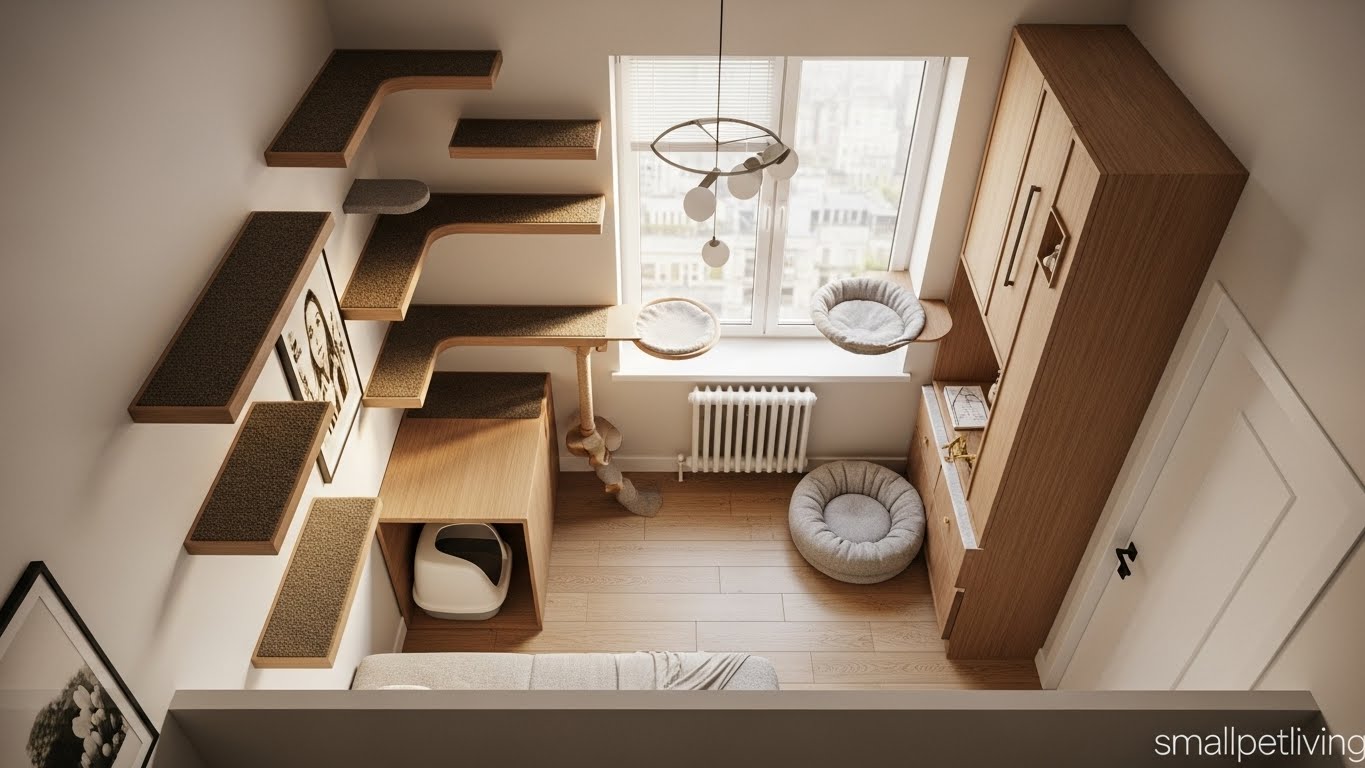
If you’re learning how to create a cat-friendly studio apartment, you’ve probably realized that space isn’t the problem—design is.
You don’t need a big home to build a happy life with your cat. In fact, a well-designed cat-friendly studio apartment can be the perfect sanctuary for both of you—even in under 500 square feet.
But here’s the truth: a studio can be the perfect home for a cat—if you design it with feline instincts in mind, not just human aesthetics.
I’ve helped dozens of urban clients transform their 400–600 sq ft spaces into peaceful co-living environments where both human and cat thrive. The secret? It’s not about buying more stuff. It’s about intentional zoning—creating micro-territories that honor your cat’s need for safety, stimulation, and solitude.
Backed by environmental enrichment science from the International Society of Feline Medicine (ISFM) and real-world urban pet success stories, this guide walks you through 9 essential zones to build into your cat-friendly studio apartment—no renovation, no clutter, no stress.
1. Why “Zoning” Beats “Decorating” Every Time
Cats don’t experience your studio as “one room.” They see it as a landscape of opportunities—and risks.
In the wild, they’d have separate areas for eating, eliminating, resting, and observing. In a studio, those functions often collide. That’s why your cat might:
- Pee outside the box (if it’s near their food)
- Hide under the bed (if there’s no quiet retreat)
- Knock things off shelves (if they’re bored or overstimulated)
The fix isn’t discipline—it’s design. By carving out 9 simple zones, you give your cat the predictability they crave. And in return, you get calm, trust, and companionship.
2. Zone 1: The Litter Box That Doesn’t Ruin Your Vibe
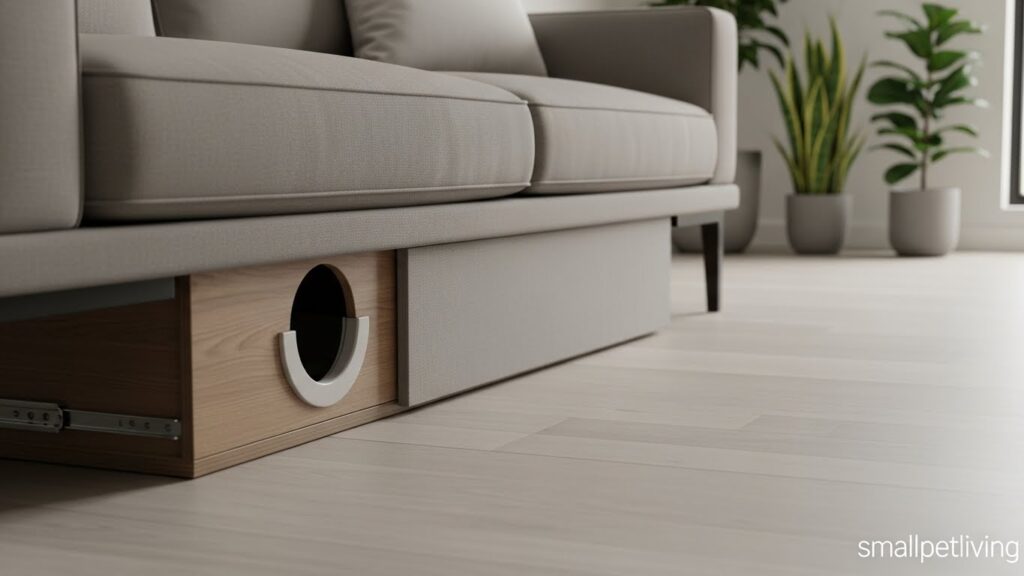
Yes, you can hide the litter box without sacrificing function.
Forget open trays in the corner. Instead:
- Slide a sealed, high-sided box (like the Modkat Flip) under your sofa
- Use a washable mat to catch stray granules
- Place it away from food, water, and sleeping areas
Cats are fastidious. If their bathroom feels exposed or smells like dinner, they’ll find a quieter spot—like your rug.
3. Zone 2: Go Vertical—Your Secret Weapon
You’re not short on space. You’re short on vertical thinking.
Mount shelves at varying heights along one wall. Add a slim cat tree in a corner. Hang a window hammock. Suddenly, your cat has a highway above the chaos—where they can nap, watch birds, or just escape when you’re hosting friends.
This isn’t just cute. It’s stress prevention. Cats feel safest when they can observe from above.
4. Zone 3: A Quiet Retreat (That’s Not Your Bed)
Even social cats need solitude. In a studio, that means carving out a low-traffic nook.
Try:
- A covered bed tucked beside your bookshelf
- A cardboard box lined with fleece (cats love enclosed spaces)
- A heated pad near a radiator in winter
Place it away from the TV, kitchen, or entryway. This is their sanctuary—not an afterthought.
5. Zone 4: The Window Perch That Pays Dividends
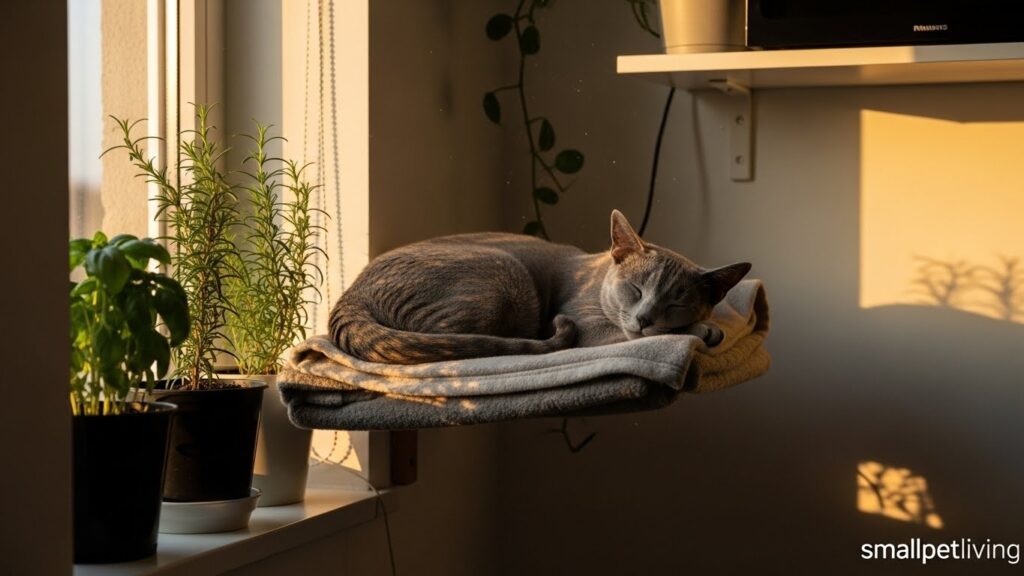
A window isn’t just a view—it’s mental stimulation. But safety comes first.
Replace flimsy plastic screens with sturdy metal mesh. Add a cushioned perch (the K&H Kitty Sill fits most sills). Then, place a bird feeder outside.
This single upgrade can reduce anxiety behaviors by up to 40%. Why? Because watching birds mimics hunting—a core feline need.
6. Zone 5: Feeding That Respects Their Instincts
Never feed near the litter box. Cats associate smell with safety—and mixing elimination with eating feels deeply wrong to them.
Instead, pick a quiet corner (beside the fridge works). Elevate bowls slightly to ease neck strain. And consider a puzzle feeder—it slows eating and engages their brain.
Small changes. Big impact.
7. Zone 6: Play That Actually Works
Wand toys left on the floor become tripping hazards. Store them in a basket. Schedule two 10-minute play sessions daily—morning and evening—to mimic natural hunting rhythms.
And rotate solo toys weekly. A crumpled paper ball today, a catnip sock tomorrow. Novelty prevents boredom-driven destruction.
8. Zone 7: Gentle Boundaries (Without Saying “No”)
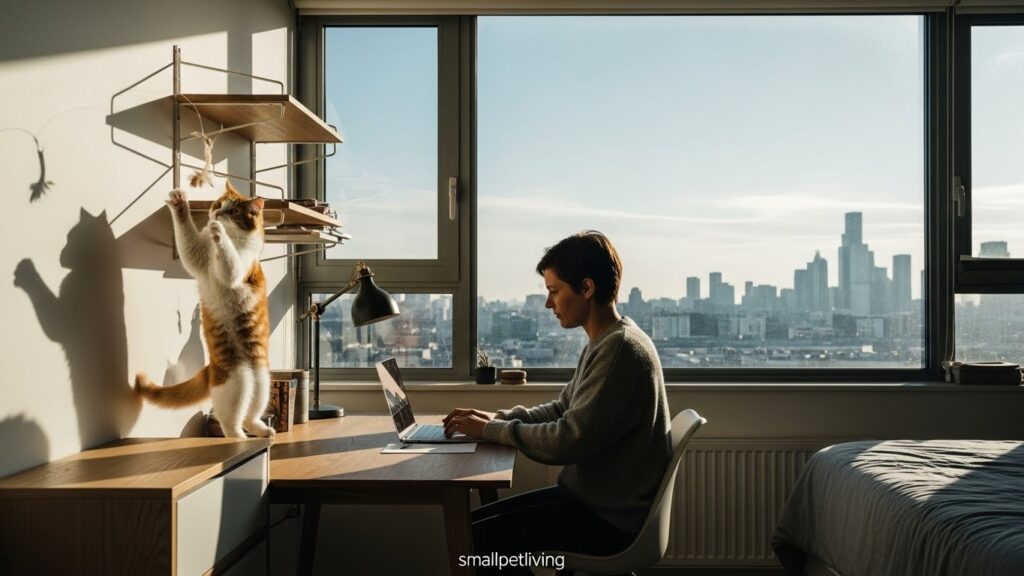
In a studio, your desk is their climbing gym. Your couch is their scratching post. Instead of constant correction, redirect.
Use double-sided tape on surfaces you want to protect. Offer a vertical scratcher nearby. Over time, they’ll learn the difference—not because you scolded, but because you gave them a better option.
9. Zone 8: The 2-Minute Emergency Plan
Urban living means fire alarms, power outages, or sudden moves. Keep a go-bag by your door:
- Carrier (leave it open so they accept it)
- 3 days of food + bottled water
- Medical records + vet contact
- A familiar blanket
You may only have 120 seconds to evacuate. Be ready.
10. Zone 9: Balcony = Danger Zone (Unless Secured)
If you have a balcony, never let your cat access it unsupervised. Even “careful” cats can slip.
Install cat-proof netting (Purrfect Fence is renter-friendly). Remove toxic plants (lilies, pothos). Secure railings with mesh.
One fall can be fatal. No view is worth that risk.
Studio Apartment Cat Setup Checklist
| Zone | Essential Item | Budget Option |
|---|---|---|
| Litter | Sealed box + mat | DIY tote with lid + pee pad |
| Vertical | Wall shelves | Floating bookshelves (IKEA) |
| Resting | Covered bed | Cardboard box + fleece |
| Window | Perch + screen | Sturdy pillow + metal screen |
| Feeding | Elevated bowls | Small wooden crate |
| Play | Wand toy + mat | String + crumpled paper |
11. What Most People Get Wrong
- Myth: “Cats adapt to any space.”
Truth: They tolerate—but chronic stress shows in subtle ways (overgrooming, hiding, litter issues). - Myth: “More toys = happier cat.”
Truth: Rotation and interaction matter more than quantity. - Myth: “Studio living is too hard for cats.”
Truth: With smart design, studios can be ideal—quiet, secure, and full of vertical opportunity.
12. Real Talk: A Client’s Transformation
Maya, 29, Brooklyn (480 sq ft)
She adopted a Russian Blue and panicked: “Where do I even put the litter box?”
We hid it under her sofa, added three wall shelves, and installed a window perch. Within two weeks, her cat stopped hiding. Within a month, she texted: “He greets me at the door now. Like he owns the place.”
That’s the power of intentional design.
13. The Science Behind the Calm
According to the Cornell Feline Health Center, cats in enriched micro-environments show:
- Lower cortisol levels
- Fewer stress-related behaviors
- Stronger bonds with owners
Why? Because they feel safe, stimulated, and in control—not trapped.
For evidence-based guidelines, see: Cornell Feline Health Center – Creating a Safe Indoor Environment
14. Your 7-Day Action Plan
- Day 1: Secure windows + add perch
- Day 2: Hide litter box
- Day 3: Install 2–3 wall shelves
- Day 4: Create resting nook
- Day 5: Organize feeding + play
- Day 6: Pack emergency go-bag
- Day 7: Observe. Adjust. Breathe.
You don’t need a bigger space. You need a smarter one.
FAQ
Q: Can this work in a 400 sq ft studio?
A: Absolutely. Most zones overlap (e.g., window = rest + enrichment). Prioritize privacy, vertical access, and safety.
Q: Renters can’t drill holes—what now?
A: Use tension rods, freestanding trees, or adhesive shelves rated for 15+ lbs.
Q: How much does it cost?
A: $150–$300 for basics. Splurge on litter box and window safety.
Q: Multiple cats?
A: Double resources: 2 litter boxes for 1 cat, 3 for 2.
Q: Can my cat sleep with me?
A: Only if you’re okay with fur and midnight kneading. Otherwise, offer a cozy alternative.
You Might Also Like
- 7 Small Cat Breeds for Apartments That Are Quiet, Low-Shedding & Truly Calm
- Low-Shedding Cat Food & Grooming Routine for Urban Living
- Quiet Cat Toys for Thin-Wall Apartments
- Why Your Apartment Cat Needs a Window Perch